
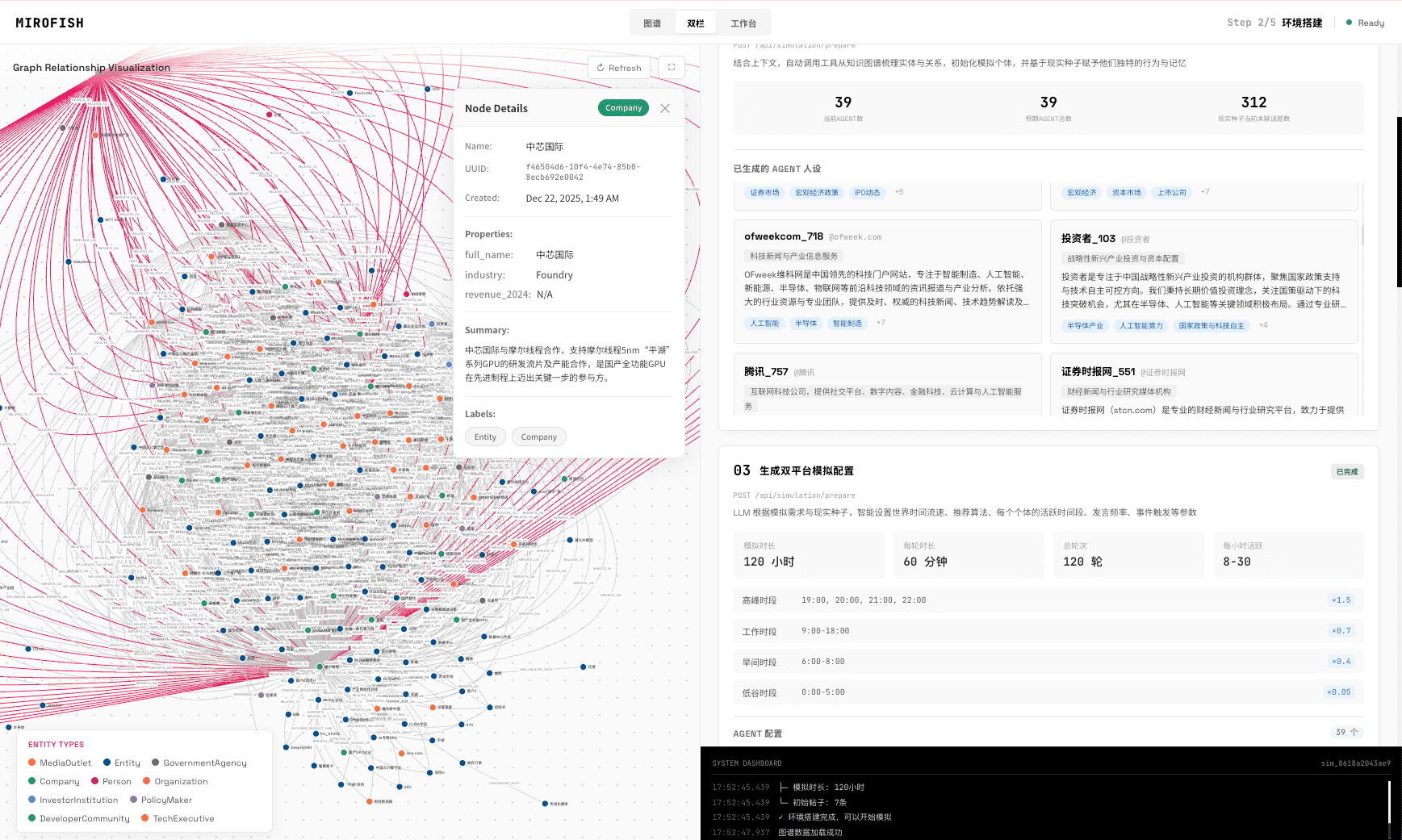
Agent-based simulation examples include product launches, pricing changes, policy announcements, crisis communication, competitive response, public opinion shifts, and B2B buying committee decisions. In BettaFish, each example should start with a source packet, visible actor graph, simulation rounds, report review, and follow-up questions. The output is a decision rehearsal, not a measured forecast.
Definition
What is a useful agent-based simulation example?
A useful example has named actors, visible assumptions, a bounded decision, reaction rounds, and a report that turns uncertainty into validation tasks.
A weak example asks an AI to predict what everyone will do. A stronger example defines the actors, the evidence each actor can see, the incentives that shape response, and the constraints that keep the simulation reviewable.
Examples
Which decisions fit agent-based simulation?
The best fit is a decision where one actor's move changes another actor's response, creating second-order effects.
| Example | Actors | BettaFish output |
|---|---|---|
| Product launch | Early adopters, skeptics, competitors, press, sales | Launch narrative, objections, proof gaps, validation tasks |
| Pricing change | Buyers, finance, procurement, competitors, champions | Resistance paths, discount pressure, value proof questions |
| Policy update | Affected groups, regulators, media, institutions | Public reaction paths, conflict points, evidence gaps |
| Crisis response | Customers, critics, employees, journalists, partners | Narrative escalation, trust risks, response checks |
| Competitive move | Incumbents, entrants, channels, buyers, analysts | Likely countermoves, delays, copycat risks, monitoring triggers |
Workflow
How do you run an agent-based simulation example in BettaFish?
Start with one decision and source packet, then review the actor graph, run simulation rounds, read the report, and ask follow-up questions.
- 1
Bound the decision
State what changed, who is affected, and what time horizon matters.
- 2
Prepare the source packet
Add product, market, policy, customer, competitor, or stakeholder evidence.
- 3
Review the graph
Check actors, relationships, incentives, constraints, and missing context.
- 4
Run the simulation
Let actor reactions compound across rounds instead of relying on one answer.
- 5
Convert to validation
Turn report claims into evidence checks, interviews, experiments, monitoring, or expert review.
Limits
What can agent-based simulation examples not prove?
They cannot prove probability, demand, sentiment, revenue, adoption, compliance, or real-world behavior without evidence outside the simulation.
Treat detailed output as a structured hypothesis. If a decision needs representative measurement, calibrated modeling, or legally accountable evidence, use BettaFish to prepare the work and validate with the appropriate method.
Simulation is not a representative survey or a deterministic forecast.
BettaFish output is designed for hypothesis generation, scenario stress testing, and research preparation. Do not present generated actors, dialogue, percentages, or reaction paths as observations from real customers or a statistically representative population.
Wake-up zone
What are the key takeaways?
- Good examples model interaction, not isolated answers.
- The source packet and actor graph determine whether the report is reviewable.
- BettaFish is useful for decision rehearsal and validation planning.
- Simulation output should not be reported as observed behavior.
Frequently asked questions
What should teams know before using this method?
Is BettaFish agent-based modeling software?
BettaFish can support qualitative agent-based decision rehearsal, but it is not a programmable ABM framework for calibrated mathematical simulation, code-based model building, or formal sensitivity analysis.
What should teams upload for agent simulation?
Upload a focused source packet: the decision, context, actor list, known constraints, evidence, assumptions, prior research, market notes, and the question the team needs to review.
What does the actor graph add?
The graph makes actors, relationships, conflicts, knowledge, and influence paths visible before the report becomes persuasive, so weak assumptions are easier to challenge.
Can AI agents predict real behavior?
No. AI agents can rehearse plausible reactions and expose assumptions, but real behavior requires validation through people, data, experiments, or accountable domain review.
Primary research to review
Agent-based simulation
Run a reviewable actor simulation before the decision hardens.
Use BettaFish to upload evidence, inspect the graph, run reaction rounds, and question the report.
Continue the cluster
Agent-Based Modeling Software
Use BettaFish for qualitative agent-based decision rehearsal with source packets, actors, graphs, reports, and review questions.
Agent-Based Simulation Software
Simulate actor incentives, constraints, relationships, and reaction rounds before committing to a decision.
Multi-Agent System Simulation
Inspect how multiple AI actors may influence one another across a shared scenario and report workflow.